Dry turning test on 321 stainless steel: 23% more parts per edge with ZCC-CT YBG205H
Two inserts at the same Vc, f and ap produced 260 and 320 parts per cutting edge on a fitting made of grade 321 stainless steel. The field trial compared the grades under dry cutting conditions.
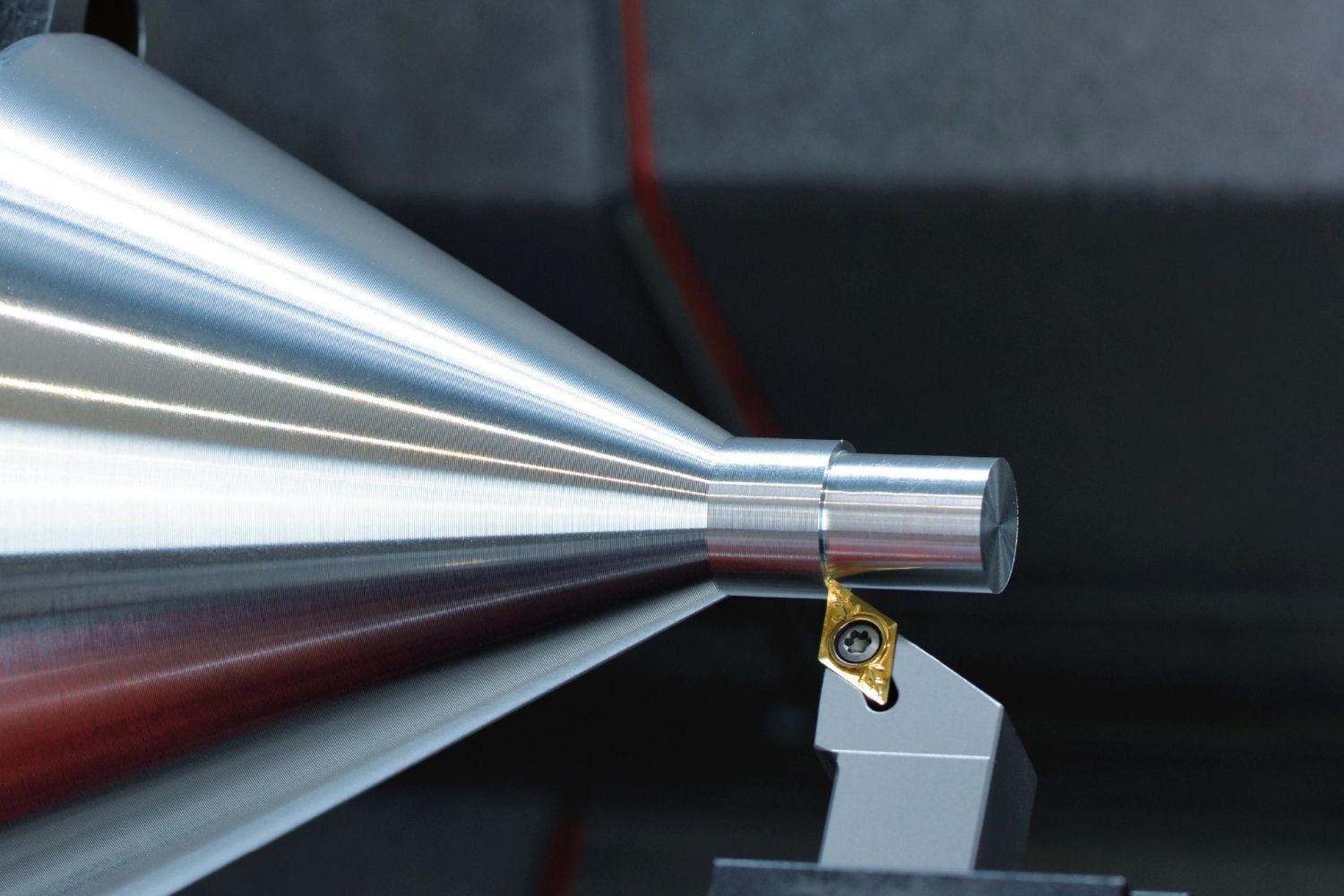
At the same cutting parameters, the insert produced 60 more parts per edge. In a dry external turning test on a fitting made of grade 321 stainless steel, the ZCC-CT TNMG160408-EM YBG205H machined 320 parts per cutting edge. Under the same conditions the European comparison insert reached 260. This is approximately 23% longer tool life. In this article, we explain the test setup, the result and stainless steel turning how to adapt it to your work.
First published: Toksan Group LinkedIn, 9 October 2026 · Extended version.
Why does heat matter when turning stainless steel?
Stainless steels, particularly austenitic grades such as 304, 316 and 321, have low thermal conductivity. Cutting heat concentrates at the edge instead of dissipating through the chip and workpiece. In dry cutting the thermal load rises further, making edge life especially important. Grade 321 is titanium-stabilised and machines much like 304. Built-up edge (BUE) and notch wear at the depth-of-cut line can occur together.
The test was run dry. Without coolant, its effects cannot mask differences between grades and chipbreakers. Interpret the result under those conditions.
Test setup
| Parameter | Value |
|---|---|
| Workpiece | 321 stainless steel union fitting, external turning |
| Inserts tested | Insert from a European brand · ZCC-CT TNMG160408-EM YBG205H |
| Cutting speed Vc | 160 m/min |
| Feed f | 0.15 mm/rev |
| Depth of cut ap | 1 mm |
| Coolant | None (dry cutting) |
| Metric | Parts machined per cutting edge |
Test result: tool life per cutting edge
With identical cutting data, the ZCC-CT YBG205H produced 60 more parts per edge; this means approximately 23% longer tool life. Since cutting speed, feed, and depth are the same for both tips, the source of the difference is largely the quality and chipbreaker geometry; the result was measured in a single test series of a single part type.
What does ZCC-CT grade YBG205H offer?
YBG205His a new-generation PVD-coated grade from ZCC Cutting Tools, also used for turning stainless steels. the ZCC-CT turning innovations catalogue (p. 97) highlighted features:
- TiAlSiN PVD coating: resists thermal shock and cracking and remains stable at high temperatures. The manufacturer recommends this grade for high-temperature turning. This probably contributed to the difference in the dry test.
- Thin coating: preserves the cutting-edge geometry. A sharp edge reduces adhesion when machining stainless steel.
- Wide range of applications: steel and stainless steel; applications up to 58 HRC hardness.
- EM chipbreaker: the catalogue describes a double-sided chipbreaker with a sharp cutting edge and large rake angle, designed for reliable medium machining and semi-roughing of stainless steel. TNMG160408-EM has a recommended range of ap 0.5–4.8 mm and f 0.10–0.45 mm/rev. The tested values of ap 1 mm and f 0.15 mm/rev are within this range.
YBG205His available in the ZCC-CT range in CNMG, TNMG, WNMG, CCMT, DCMT and TCMT shapes, with EF and EM chipbreakers. TNMG160408-EM is one example. For choosing a grade and geometry for stainless steel, see our stainless steel material page .
What does 60 pieces in mass production mean?
In series production, part count alone does not tell the whole story. Longer edge life means fewer insert changes, less downtime and less risk of dimensional drift. On a line machining 10,000 parts a month, 260 parts per edge require 39 edge changes. At 320 parts per edge this falls to 32, saving 7 stops and 7 new edges each month. To include downtime in the cost calculation, you can use the cost per part calculation in our article method.
Applying the findings to your operation
- Parameters were selected for this part and this cross-section; results will vary with different diameters, ap and feeds. Run two edges with the same parameters in the same shift during your own test.
- Coolant may narrow or widen the difference observed during dry cutting. For more on coolant effects, see our article on built-up edge in stainless steel for details.
- Select the chipbreaker for the intended ap and f range. EF is better suited to finishing and EM to medium machining or semi-roughing. For starting values, see the guide to turning parameters for further details.
Frequently asked questions
Which cutting parameters were used for the test?
Vc 160 m/min, f 0.15 mm/rev and ap 1 mm, without coolant. The outside diameter of a 321 stainless steel fitting was turned using identical cutting data for both inserts.
How was the 23% increase calculated?
(320 − 260) ÷ 260 = 0.23, or 23% more parts per cutting edge. In this test that corresponds to 23% longer tool life.
Is YBG205H only for stainless steel?
No. The catalogue recommends it for steel and stainless steel and covers applications up to 58 HRC. It is particularly suited to high-temperature turning operations with a high thermal load, such as dry cutting.
Tell us about your part and cutting conditions so we can select a ZCC-CT grade together
We can help you select the ZCC-CT grade and geometry for your part and cutting conditions.
Related articles: When the insert lasts only 20 parts on a 42CrMo4 shaft · How to select a cutting insert? · CNMG inserts