
CNMG · ZCC-CT turning inserts
CNMGis the most common negative turning insert shape: an 80° double-sided rhombic insert with a hole. This page explains the CNMG code, dimensions, chipbreakers, cutting parameters and compatible holders. All data come from the ZCC-CT General Turning catalogue.
Shape → 80° rhombic
Size → 0903 · 1204 · 1606
Corners → 4 usable corners
Size → 0903 · 1204 · 1606
Corners → 4 usable corners
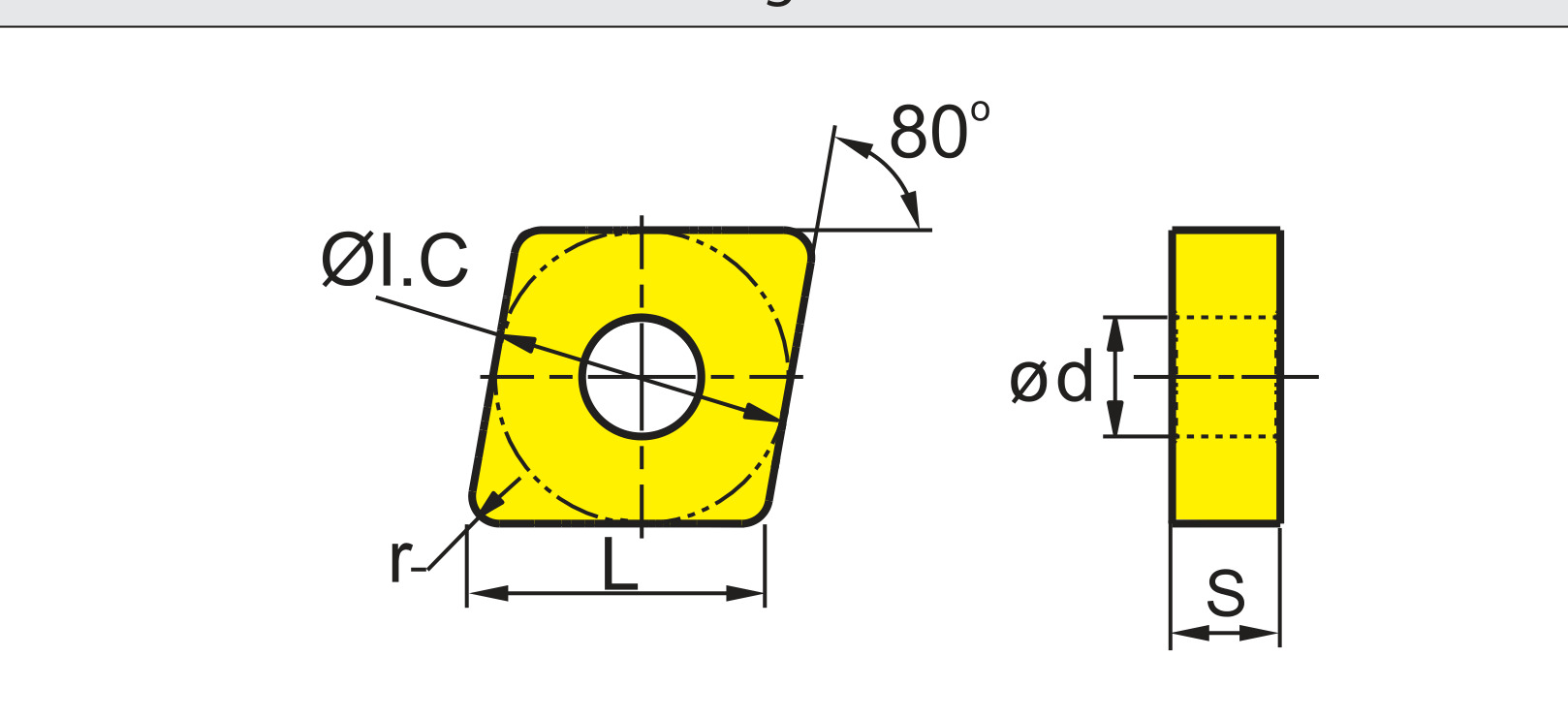
How to read the CNMG code
Each letter and digit has a meaning under ISO 1832. Example: CNMG120408-PM YBC252
| Element | Meaning |
|---|---|
| C | Shape: 80° rhombus |
| N | 0° clearance angle: negative, double-sided |
| M | Tolerance class M (medium precision, most common) |
| G | Centre hole and chipbreaker on both sides |
| 12 | Edge length group (12 → I.C. 12.7 mm) |
| 04 | Thickness group (04 → 4.76 mm) |
| 08 | Nose radius: 0.8 mm (04 → 0.4 · 12 → 1.2 · 16 → 1.6) |
| -PM | Chipbreaker geometry (see table below) |
| YBC252 | Carbide grade (selected by material) |
CNMG dimensions
| Size | L — edge length (mm) | I.C. — inscribed circle diameter (mm) | S — thickness (mm) | d — hole diameter (mm) |
|---|---|---|---|---|
| 09 03 | 9,7 | 9.525 | 3,18 | 3,81 |
| 12 04 | 12,9 | 12,7 | 4,76 | 5,16 |
| 16 06 | 16,1 | 15.875 | 6,35 | 6,35 |
CNMG chipbreaker selection and cutting parameters
The following values apply to CNMG120408 (0.8 mm nose radius). ap = depth of cut, f = feed.
| Chipbreaker | Application | ap (mm) | f (mm/rev) |
|---|---|---|---|
| -PM | Medium machining and roughing: standard option for steel | 0,5–5,5 | 0,15–0,50 |
| -DM | Medium machining and roughing, steel and cast iron | 0,5–5,5 | 0,15–0,50 |
| -EM | Roughing, high metal removal rate | 0,5–5,7 | 0,15–0,45 |
| -NM | Medium machining of superalloys | 0,2–4,0 | 0,10–0,50 |
| -WG | Wiper: better surface finish at the same feed | 0,5–5,0 | 0,15–0,70 |
| -ADF | Finishing and medium machining | 0,5–3,0 | 0,10–0,40 |
| -DF | Finishing | 0,3–1,5 | 0,10–0,40 |
| -EF | Finishing with low cutting forces | 0,5–2,5 | 0,05–0,25 |
| -SF | Fine finishing for thin-walled parts | 0,1–1,5 | 0,10–0,35 |
Rule of thumbNose radius limits feed. As a rule of thumb, f ≤ half the nose radius. With a 0.8 mm radius, exceeding 0.4 mm/rev impairs the surface and loads the edge. Use a larger radius for roughing (1.2–1.6) and a smaller one for finishing (0.4).
CNMG grade selection by material
| Workpiece material | ISO | ZCC-CT grades |
|---|---|---|
| Steel | P | YBC252 YBC152 YBC352 YBC103 |
| Stainless steel | M | YBM253 YBM153 YBG205 |
| Cast iron | K | YBD152 YBD102 |
| Aluminium and non-ferrous metals | N | YD101 YD201 |
| Superalloys (Inconel, Ti) | S | YBS103 YBG105 |
| Hardened steel | H | YBG102 YBG101 |
| Finishing — cermet | — | YNT251 YNG151 · see cermet insert |
Which toolholders accept CNMG inserts?
Negative CNMG inserts fit wedge- or screw-clamped holders. Compatible holder families and entering angles (Kr) from the catalogue:
| Toolholder | Entering angle Kr | Application |
|---|---|---|
| PCLNR/L | 95° | External turning — most common |
| DCLNR/L | 95° | External turning, alternative clamping |
| MCLNR/L | 95° | External turning, wedge clamping |
| PCBNR/L | 75° | Facing and external turning |
| MCBNR/L | 75° | Heavy roughing |
| A***-PCLNR/L | 95° | Boring bar for internal turning |
R denotes a right-hand holder and L a left-hand holder. Overhang is critical in internal turning. See our guide to reducing chatter for details. For all dimensions and order codes, see the General Turning catalogue (PDF, 380 pages). For grade descriptions, see the ZCC-CT Europe grade table.
Frequently asked questions
What is the difference between CNMG and DNMG?
The corner angle is 80° for CNMG and 55° for DNMG. The stronger CNMG corner gives longer life in roughing. The narrower DNMG angle reaches profiled and sloping surfaces. Details: rhombic inserts (DNMG/KNUX).
How many corners can be used on a CNMG insert?
Four. A double-sided negative insert has two usable corners on each side. This substantially reduces the cost per corner compared with single-sided inserts.
Should I choose CNMG120408 or CNMG120404?
The final two digits indicate the nose radius: 08 = 0.8 mm and 04 = 0.4 mm. A 0.8 mm or even 1.2 mm radius strengthens the edge for roughing and higher feeds. A 0.4 mm radius is more suitable for fine finishing, thin walls and precise corners.
Can I use the same insert for steel and stainless steel?
The shape can be the same, but the grade differs. For steel, use a CVD-coated P grade such as YBC252. For stainless steel, use an M grade such as YBG205 or YBM253. The wrong grade can halve tool life. If in doubt, send us the material designation.
Where can I buy genuine ZCC-CT CNMG inserts?
Toksan has been ZCC-CT’s authorised distributor in Türkiye since 2004. CNMG inserts with a range of chipbreakers and grades are dispatched from stock. For other shapes, see the turning insert guide and cutting insert guide pages.
Stock and priceSend the CNMG code you need (e.g. CNMG120408-PM YBC252) and we will confirm stock and price the same day. If you do not know the code, tell us the material and type of operation.