

Toolholding systems
TCR Hassas Tutucu Sistemleri is the Toksan Group’s toolholding company. We manufacture standard and custom holders in Nilüfer, Bursa. Compare models for your machine interface, then check drawings and ordering dimensions on the TCR product pages.
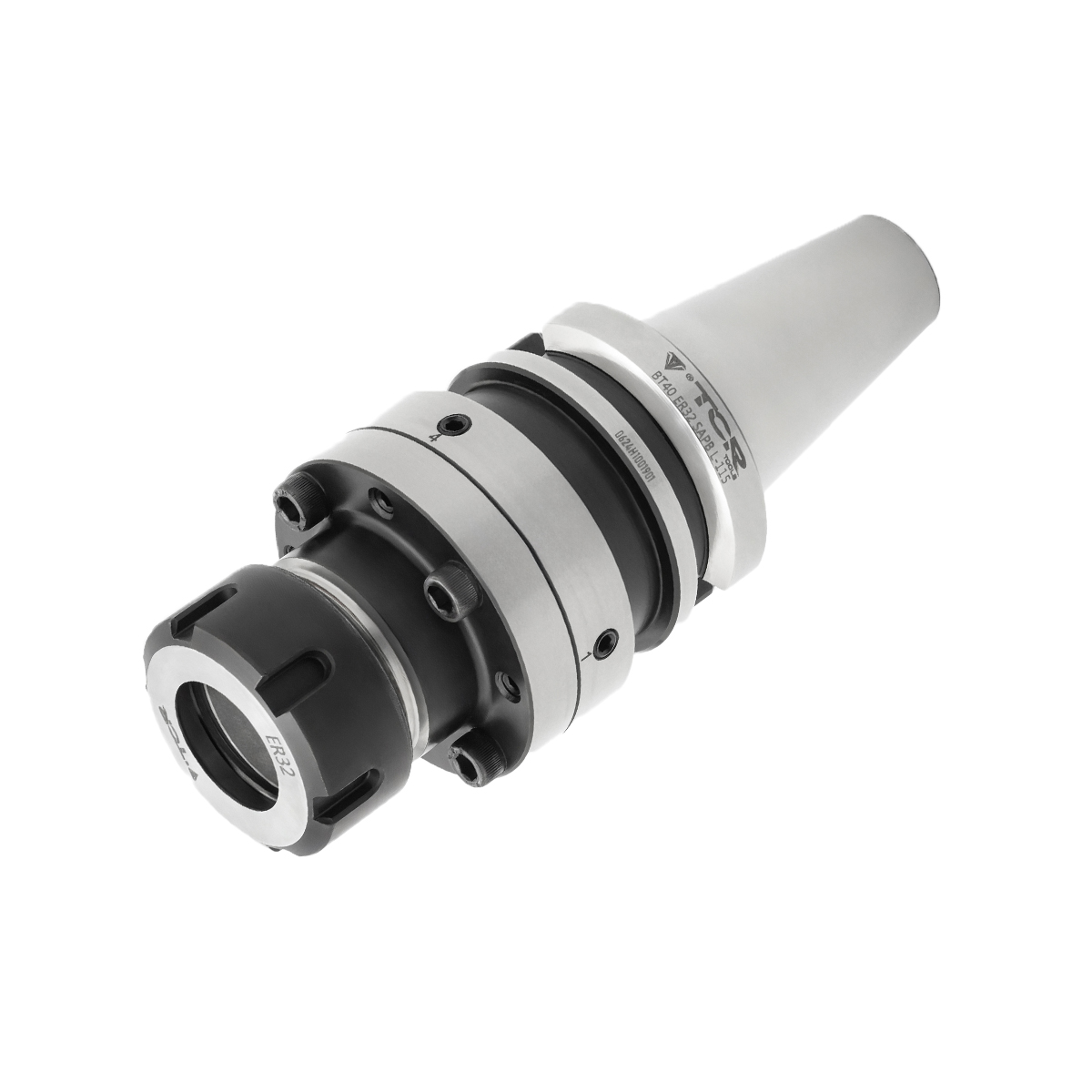
Which toolholding systems suit your machine?
First identify the spindle interface on your machine. BT40 and HSK63-A, for example, describe the machine side of the holder. Then select the clamping method to suit the cutter shank, tool-change frequency and cutting load.
BT40 · ER
ER collet chuck
An ER collet chuck can hold drills and end mills in the same body. Check the shank diameter before changing cutters. If the diameter is unchanged, you may reuse the same collet. For a different diameter, fit the corresponding collet.
Selection criteria Match the shank diameter to the collet’s clamping range. Check that the collet is fully seated in the nut and select the wrench for the nut type.
BT40 · Thin-walled
Hydraulic expansion chuck
Hydraulic expansion chucks use oil pressure to deform a thin wall and grip the cylindrical shank around its circumference. In narrow pockets especially, check the outside diameter of the holder nose against the part cross-section.
Selection criteria Before loading a hydraulic chuck, check the shank tolerance and minimum clamping length for that model. If using a reduction sleeve, verify compatibility with both chuck and shank.
HSK63-A · DIN 1835-B
Weldon holder
The side-lock screw bears against the flat on the shank, helping prevent the cutter from rotating in the holder during rough milling.
Selection criteria Check the shank diameter and the position of the flat, then make sure the screw bears on that flat. In deep pockets, leave adequate clearance for the body of the Weldon holder.
Which ER collet series fits a BT40 toolholder?
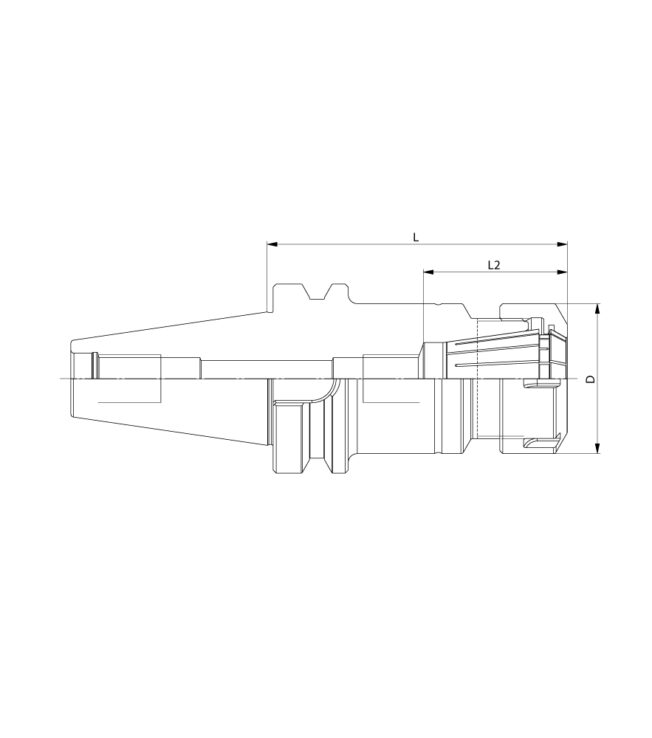
Standard BT40 ER series · technical drawing
D nut outside diameter · L — length from the reference face to the holder nose · L2 front step length
| Order code | Shank diameter¹ | L | D | L2 |
|---|---|---|---|---|
| ER16 and ER25 toolholders | ||||
| TCR- | 1–10 | 100 | 28 | 32 |
| TCR- | 2–16 | 100 | 42 | 42 |
| ER32 toolholders · 100 and 130 mm | ||||
| TCR- | 2–20 | 100 | 50 | 48 |
| TCR- | 2–20 | 130 | 50 | 48 |
¹ The table gives the minimum and maximum tool shank diameters for each ER series. Select the correct collet for your cutter’s shank diameter.
A Ø12 mm end mill shank can be clamped in ER25 or ER32. If the nut must enter a 46 mm wide slot, its outside diameter matters. An ER25 nut with a 42 mm outside diameter, centred in the 46 mm slot, leaves 2 mm clearance on each side. A Ø50 mm ER32 nut does not fit. Check clearance to the workpiece and fixture along the whole toolpath.
How is toolholder runout measured?
Record the measurement point
Clamp a suitable test arbor in a clean holder and bring the dial indicator tip into contact with its cylindrical surface. Rotate the arbor through one full revolution and record the highest and lowest readings. Their difference is the total indicated runout (TIR).
Before comparing toolholders, record the test arbor diameter and the distance from the measurement point to the holder nose. The distance can affect the result even on the same holder. Use the distance and runout limit specified for the particular TCR model.
Example measurement · Ø12 mm test arbor
0.008 mm = 8 µm
For example, at 36 mm from the holder nose, indicator readings of +0.006 mm and −0.002 mm give a total runout of 0.008 mm. The difference is 8 µm. Judge acceptance against the specified measurement distance and limit for that holder.
Discuss toolholder selection with the TCR technical team
For help choosing a toolholder, tell TCR the machine model, spindle interface, cutter shank diameter and operation. If access is restricted, mark the narrowest passage, target surface and fixture position on a section drawing. The team can then check whether a standard holder fits or a custom body is needed.