
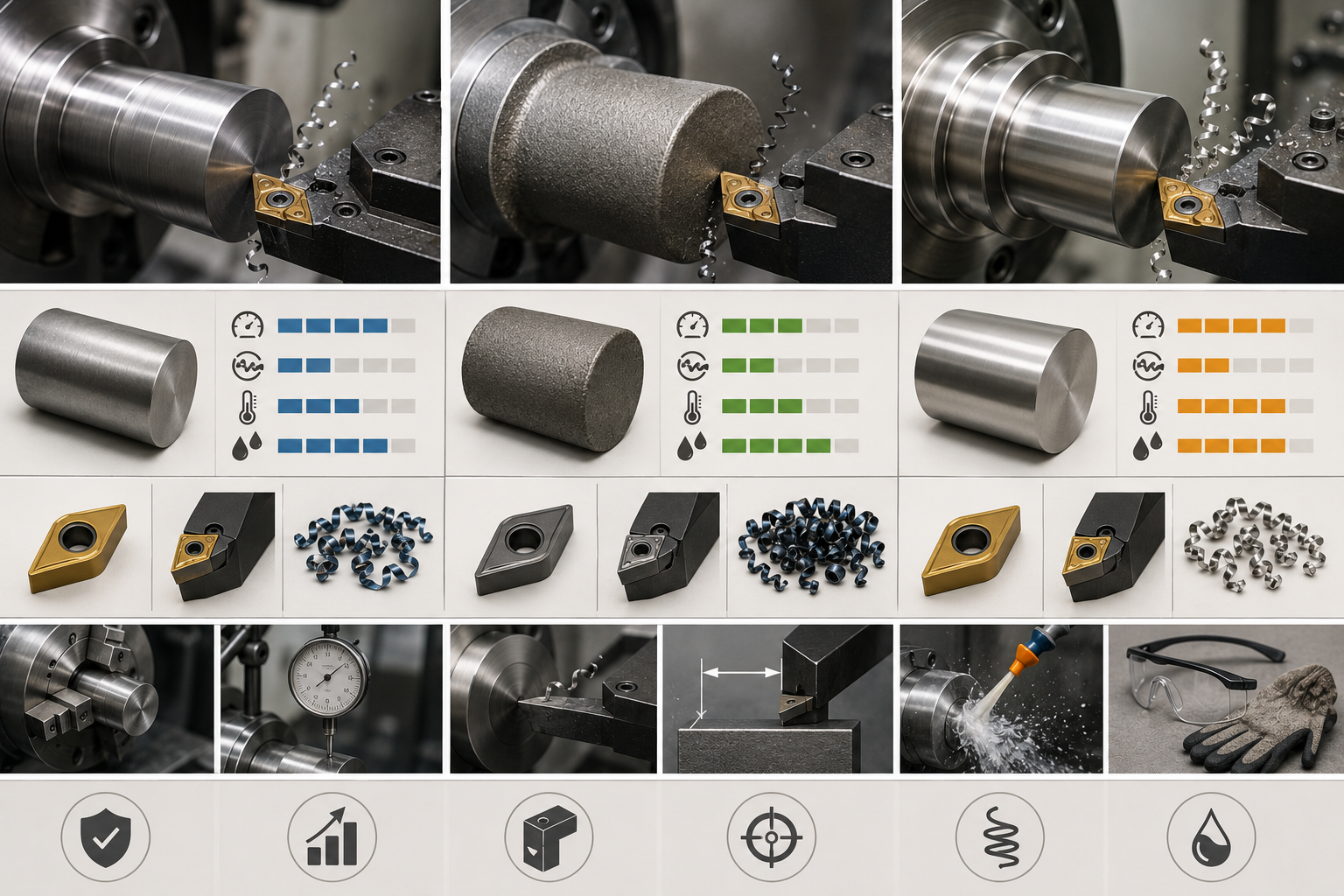
That is exactly what I will do in this article 🤝 That is, I won’t just give you rote tables like “this many RPMs, this much feed”; instead, we will talk about why a moderately stable start is logical in steel, why a dry and controlled approach is often safer in cast iron, and why in stainless steel, being overly cautious can sometimes produce more heat and a worse surface. Toksan’s turning solutions, holders and accessories, testing and custom tool manufacturing, customer training, general engineering and sector solutions for series production by combining it with this approach. Because a safe start in turning is not just about insert selection; it becomes truly safe only when material behavior, clamping, tool overhang, cooling, chip evacuation, and operator discipline are considered together 🚀
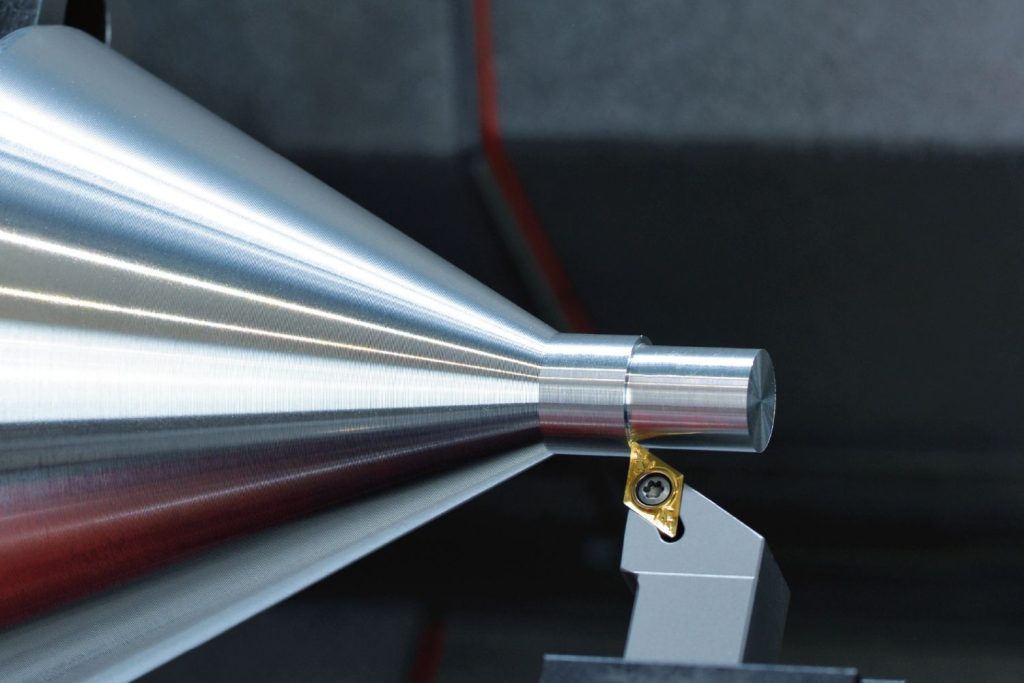
What exactly is a safe starting point in turning? 🎯
Safe starting doesn’t mean minimising everything as many people assume. On the contrary, this approach can sometimes lead to the most expensive mistakes 😅 Especially in stainless steel, very low speeds and very low feeds can increase friction; in steel, unnecessarily low speeds can cause built-up edge and poor surface finish; in casting, an incorrect cooling strategy can lead to thermal shock and fluctuations in tool life. Therefore, what I mean by a safe start is: the parameter window where the tool actually begins to cut, the chip is under control, the heat remains manageable, the machine feels stable, and the operator can reliably take measurements on the first few parts..
Toksan’s turning page This is why mentioning precision, productivity, long tool life, and minimum machining time together is important. Because in real life, simply extending tool life is not enough; cycle time, surface quality, and process reliability must also be considered together. The same logic in toolholding systems also applies; reducing vibration, balance errors, and axial misalignments with the correct holder significantly expands the safe starting window.
How do steel, cast iron and stainless steel affect the tool differently? 🔍
Let’s think of materials as three characters 😊 Steel is generally the most “compliant” character. It has a wide range of applications, appears in many different hardnesses, and can give quite predictable results with the right grade. Casting behaves more brittle, usually produces good chips but silently wears down the tool with its abrasiveness. Stainless steel is the most temperamental character; it is prone to adhesion, retaining heat in the cutting zone, notch wear, and work hardening. So, all three are turned, but they are not approached with the same logic.
| Material group | Main characteristics in turning | What to watch when choosing starting values | Most common mistake |
|---|---|---|---|
| Steel | Wide application range, moderate heat and built-up edge risk | Balanced speed, medium feed, reliable chip control | Running too slowly, causing rubbing and built-up edge formation |
| Cast iron | Abrasive material, generally short chips | Monitor wear, keep the cut stable and assess dry cutting or a suitable coolant strategy for the application. | Unsuitable cooling and an unnecessary emphasis on a sharp edge |
| Stainless steel | Heat, adhesion, notch wear, work hardening | Adequate feed to maintain cutting, heat control and rigid clamping | Taking too cautious an approach and increasing friction |
In its workpiece material classification, Sandvik Coromant identifies heat, notch wear and built-up edges as concerns for stainless steels. Its general turning guidance notes that too low a cutting speed can produce a built-up edge, blunt the cutting edge and spoil the surface finish. Speed, feed and depth of cut need to be optimised together to improve tool life. For ISO K cast irons, abrasiveness is a deciding factor in application selection. A safe starting range therefore depends on the workpiece material. :contentReference[oaicite:0]{index=0}
Insight 1. A safe starting point still needs cutting conditions that allow the edge to cut. ⚠️
To protect the tool on the first part, operators and engineers sometimes reduce all the cutting parameters. It seems logical, but very low speed and feed can be counterproductive. If the edge removes too little material, it rubs. Friction generates heat, which can shorten tool life, damage the surface and compromise tolerances. The effect is particularly noticeable in stainless steel. Kennametal points out that operating outside the recommended speed and feed can cause rubbing, increasing heat and the risk of work hardening. A safe starting point is one at which the edge actually forms a chip. :contentReference[oaicite:1]{index=1}
I always explain this logic with this metaphor 😊 Riding a bicycle very slowly seems safe at first; but sometimes you go so slowly that you lose balance. It is the same in turning. Cutting too slowly does not always protect you; sometimes, on the contrary, it destabilises the process.
Insight 2: How do you choose safe starting conditions for steel? 🔩
For steel, I generally start in the middle of the range. 😊 ISO P covers a wide span of alloys and hardnesses. At the start, the priorities are usually reliable chip breaking, predictable wear and a balance between finish and dimensional accuracy. A medium-duty grade, a dependable general-purpose geometry, a moderate cutting speed and a feed that lets the operator judge the sound of the cut make a practical starting combination. Avoid very low speeds. As Sandvik points out, they can lead to built-up edges, blunt cutting edges and poor surface finish. :contentReference[oaicite:2]{index=2}
A framework for safe starting conditions: Your first goal with steel should be the feeling that the tool is “cutting cleanly.” If the chip isn’t winding up uncontrollably, if the surface isn’t matte and torn, and if the dimension remains stable over the first few parts, you are in the right window. If the chip is long and bothersome, consider the geometry and chipbreaker first; if the surface is poor, instead of just increasing or decreasing the speed, review the tool center, holder rigidity, and tool overhang. Toksan’s general engineering and automotive The application engineering approach, which responds to different series production and general machining needs, is highly valuable in translating this middle and safe starting logic into the field for steel.
Insight 3: Why do starting conditions differ for cast iron? 🪨
The work changes slightly in casting. Because here, chip breaking is often not as big of a concern as in steel; the real issue is the abrasive structure eating away at the tool quietly. Casting materials, especially types like grey cast iron, can produce more regular chips due to brittle chip behavior but can simultaneously cause serious wear on the cutting edge. Therefore, a safe start in casting is sometimes a more “wear-aware” start than in steel. It is very dangerous to become complacent because the first part looks good. The tool doesn’t fail suddenly, but often gradually.
Coolant strategy is another important decision in cast iron. Many operations use dry cutting or a controlled coolant supply because intermittent cooling can cause thermal shock. What works depends on the cast iron and the operation, so a setup used for steel should be reassessed before applying it to cast iron. Seco’s approach to matching grades and geometries to materials and Sandvik’s discussion of wear mechanisms in different material groups both support this distinction. :contentReference[oaicite:3]{index=3}
A framework for safe starting conditions: In casting, read tool life from wear behaviour, not from a single surface. Don’t push the parameters immediately just because the first part looks good. Start with a stable ap, an initial feed per revolution that the machine accepts without vibration, and a grade selection that can withstand abrasive structures. If the surface is very good but the edge is wearing quickly, the problem isn’t “surface looks good, keep going”; the problem is the accumulation of silent costs. Toksan’s testing and custom tool manufacturing and energy engineering and its process-oriented approach in heavy machining areas becomes particularly meaningful in wear-centric applications like casting.
Insight 4: Why is a safe start for stainless steel the most misunderstood topic? 🌡️
A common mistake in stainless steel is to reason that a difficult material should be machined as slowly as possible. That sounds plausible but can make the cut worse. 😅 Stainless steel tends to retain heat in the cutting zone, encourages adhesion and built-up edges, and can develop notch wear and work hardening. If cautious settings prevent the tool from cutting properly, the material rubs and heats up, making subsequent passes harder. Kennametal’s warning about work hardening and Sandvik’s explanation of built-up edge formation at low speed both describe this effect. :contentReference[oaicite:4]{index=4}
For stainless steel, a safe start often means a light but positive cut. 😊 The edge needs to form a chip rather than rub, coolant needs to reach the cut, and tool overhang should be kept as short as possible. Where possible, begin with a rigid setup, reliable coolant delivery and a geometry intended for stainless steel. Sandvik lists heat, notch wear and built-up edges among the typical risks for this material. A sound starting setup therefore needs both thermal and mechanical control. :contentReference[oaicite:5]{index=5}
Toksan’s toolholding systems emphasises checks for vibration, balance and misalignment. These matter even more in stainless steel because poor clamping aggravates heat and adhesion. Similarly, technical training helps operators machine stainless steel with an understanding of the material and its behaviour.
Insight 5: Why do geometry, grade and holder matter as much as cutting data when starting? 🛠️
When asking for starting parameters, many people mean only speed, feed and depth of cut. These cannot compensate for unsuitable geometry or a weak holder. In steel, the wrong chipbreaker can produce long chips and an unreliable process. In cast iron, the wrong grade can accelerate wear. In stainless steel, unsuitable geometry can aggravate adhesion and notch wear. Add holder runout, excessive overhang or poor clamping, and even good catalogue figures deliver only average results. Toksan toolholders and accessories page explains how vibration, imbalance and misalignment on high-speed CNC machines can reduce surface quality, shorten tool life and impair dimensional accuracy. That is why a safe starting setup involves more than a set of numbers. :contentReference[oaicite:6]{index=6}
I picture a kitchen knife and a chopping board 😊 Even an excellent knife cuts poorly on a surface that rocks. The same applies to machining. Good geometry and a good grade cannot reach their full potential in an unstable setup.
Practical start-up: what should you check on the first 10 parts? 👀
I treat the first 10 parts as a trial of the starting conditions on the machine. On those first 10 parts, ask a few questions. 😊 Is the chip form under control? Does the cut sound steady? Are there dull tears, shiny rubbing marks or waviness on the surface? Do dimensions drift quickly? Does the edge show early adhesion, notching or excessive flank wear? If most checks look satisfactory, you have found a safe starting range.
For this reason, Toksan’s testing and demonstration centre and testing facilities approach is valuable because controlled trials and observation reveal a reliable starting range. With a new material, part geometry or tooling combination, tested limits are a safer basis than settings passed on by word of mouth. :contentReference[oaicite:7]{index=7}
| First check | What to expect with steel | What to expect with cast iron | What to expect with stainless steel |
|---|---|---|---|
| Chip behaviour | Controlled chip breaking or manageable chip length | Usually short, brittle chips | Manageable but stickier chips that require close attention |
| Surface finish | Consistent, stable surface finish | Functional, uniform surface | Bright surface without rubbing marks |
| Type of wear | Built-up edge or normal flank wear | Abrasive flank wear | Notching, adhesion, heat-related wear |
| First adjustment | Balance chip control and cutting speed | Check the grade and monitor wear | Balance heat, feed and clamping |
Why do three materials behave differently on the same machine with the same operator? 💬
I once saw 42CrMo4 steel, grey cast iron and then 316 stainless steel machined on the same lathe. The experienced operator initially took a similar approach to all three. Steel ran reasonably well. In cast iron, tool life fell short of expectations. In stainless steel the first part looked good, but by the third the sound had changed and material was sticking to the edge. The mistake was assuming the materials behaved alike. Once we adjusted cutting data, geometry and clamping for each material, all three operations became more reliable. It taught me to learn the behaviour of each material rather than memorise a list of numbers ❤️
Identify a stable operating range before increasing cutting data 🌟
On a new job, I first look for a range where the behaviour of the machine and material can be read clearly. A stable process gives you useful feedback. If you push too hard from the first part, noise, vibration and wear overlap, and it becomes difficult to distinguish cause from effect. Find a safe range first, then explore its limits in controlled steps. 😊 That is why Toksan’s training, testing and toolholder together form an approach I value because a sound start lays the foundation for later optimisation.
SELECTING SAFE STARTING CONDITIONS

Which material is being machined?
   ├── Steel
   │     ├── Moderate cutting speed and feed, stable chip control
   │     └── Avoid very low cutting speeds
   │
   ├── Cast iron
   │     ├── Monitor wear
   │     ├── Assess dry cutting or an appropriate coolant strategy
   │     └── Check the grade choice early
   │
   └── Stainless steel
         ├── Avoid cutting conditions that cause rubbing
         ├── Monitor heat and adhesion
         └── Start with rigid clamping and a suitable feed

For all materials:
   → Observe the first 10 parts
   → Assess chips, sound, finish, dimensions and wear together
   → Then optimise in controlled steps
A good start gets a turning operation halfway there ✅
To sum up 😊 Starting safely in steel, cast iron and stainless steel calls for settings matched to each material. In steel, look for a balanced process that is easy to monitor. In cast iron, monitor wear closely. In stainless steel, avoid rubbing, manage heat and provide rigid clamping. In all three, a reliable starting point is one where the tool is cutting, the chips are manageable, the machine runs steadily and the operator can assess what is happening on the first few parts.
Toksan’s turning products, toolholding solutions, testing and custom tooling services, technical training approach and industrial applications perspective matters because a sound start in turning gives you a basis for improving productivity and tool life with confidence. From the first part onward, machine, tool and material should be working reliably together. 💙
Frequently asked questions ❓
1) Should you always start at a low cutting speed?
No. On some materials, a very low speed can cause built-up edge, rubbing and poor surface finish.
2) What should I check first when turning steel?
Usually the first checks are chip control, the condition of the machined surface and any early signs of material sticking to the cutting edge.
3) Why do tools wear quickly in cast iron?
Cast materials are often abrasive and can wear down a cutting edge rapidly without obvious warning signs.
4) Why can an overly cautious approach to stainless steel give poor results?
Very low cutting data can cause the tool to rub against the workpiece and generate more heat.
5) Which matters more when choosing initial cutting data, feed or speed?
Both matter, but the more critical one depends on the material. In stainless steel, maintaining sufficient feed to prevent rubbing is particularly important.
6) Does the holder really affect the starting parameters?
Yes. An insufficiently rigid holder can cause vibration and misalignment, reducing the stable operating range.
7) What should I monitor on the first 10 parts?
Monitor chip shape, sound, surface finish, dimensional drift and tool wear together.
8) Is using coolant on cast iron always a mistake?
No. Assess thermal shock risk together with the application before deciding.
9) Is a shiny surface on stainless steel always a good sign?
No. Sometimes a shiny surface can be an early sign of rubbing and adhesion.
10) What comes after a safe start?
Once a stable range is established, use controlled optimisation to improve productivity and tool life together.
People also ask 🔎
How can you detect built-up edge early when turning steel?
When does dry turning make more sense for cast iron?
How can you recognise notch wear in stainless steel?
For a safe start, should you choose CNMG or a more positive geometry?
Why might the finish be good on the first part but deteriorate by the fifth?
Why does the same tool have a different life in each of three materials?
How does vibration affect otherwise safe starting parameters?
How should initial settings be chosen to build operator confidence?
How long should starting conditions be maintained in series production?
When does testing centre support make a real difference?