Chatter in internal turning is one of the most serious causes of poor surface finish, short tool life and dimensional errors that increase scrap. In deep bores and when using boring bars with a high length-to-diameter ratio, uncontrolled chatter directly increases manufacturing costs.
The most common mistake we see on the shop floor is looking in the wrong place for the cause. Tools are replaced unnecessarily, cutting parameters are reduced by trial and error and process signals are misread. Chatter is more than the machine shaking. The interaction of cutting forces with the system’s natural frequency produces regenerative chatter . The waviness left by the previous revolution changes the cutting force on the next revolution, creating a feedback loop with increasing amplitude.
A typical case starts with a rougher surface. The operator reduces feed, lowers spindle speed and changes the depth of cut, yet the vibration persists. The missing checks are structural rigidity, tool overhang and clamping quality. This article examines their relationship: Tool overhang, clamping and cutting parameters.
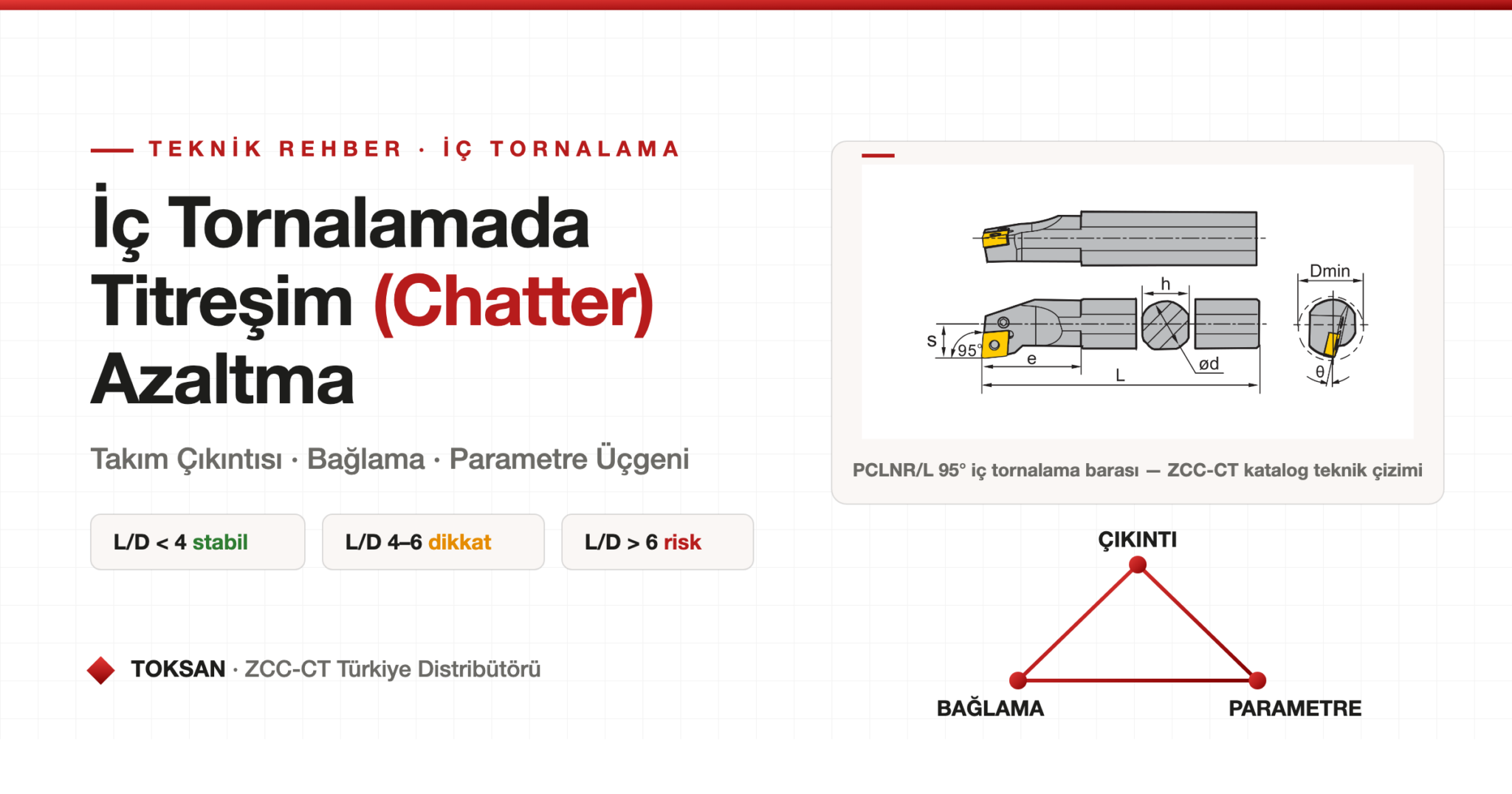
L/D 4–6 → caution
L/D > 6 → high risk
L/D > 8 → a damped boring bar is essential
Why is external turning easier and internal turning more susceptible to chatter?
The essential difference is the stiffness of the system under the cutting force. In external turning the holder is short and rigid. In internal turning, a boring bar behaves like a beam as its overhang increases, and its deflection rises sharply.
According to beam theory, elastic deflection increases approximately with the cube of the length . Doubling the overhang increases deflection by roughly a factor of eight. This is why internal turning is far more sensitive than external turning.
| Criterion | External turning | Internal turning |
|---|---|---|
| Tool stiffness | High | Low, especially with long overhangs |
| Risk of vibration | Medium machining | High |
| Consistency of surface finish | More stable | Very sensitive to changes in cutting parameters |
| Critical factor | Cutting force | L/D ratio and clamping |
This comparison has practical consequences. Many production problems stem from this difference in stiffness. Once it is understood, the appropriate remedy often becomes clear.
Tool overhang: an often overlooked factor
Tool overhang, expressed as the L/D ratio, is the strongest influence on chatter. An L/D below 4 is considered relatively stable. Above 6 the risk rises considerably, and above 8 vibration is almost inevitable without a specially damped boring bar.
When machining a deep hydraulic cylinder housing, an operator kept replacing inserts. The surface was wavy and tools were breaking. An investigation found that the boring bar had an L/D ratio of around 9 and that a conventional carbide bar was being used. Switching to a vibration-damped boring bar at the same cutting parameters improved the finish markedly and roughly doubled tool life.
If you cannot reduce tool overhang, consider the following options in this order:
- Use a larger-diameter boring bar
- Choose a carbide or damped boring bar
- Reduce the depth of cut
- Adjust cutting speed to move away from the system’s natural frequency
Clamping quality: the weak link in the stiffness chain
Many manufacturers focus on the tool alone. Yet the quality of the clamping setup — chuck clamping force, tailstock support and contact surfaces — directly affects chatter. Cutting forces cause elastic deformation in both the tool and the workpiece.
For thin-walled workpieces or long shafts, review how the workpiece is supported. A rigid setup often matters more than changing the cutting parameters.
An internal turning setup is like a guitar string. Too little tension allows vibration to build, while excessive tension can snap the string. With the right tension and support, vibration stays under control and troublesome resonance is avoided.
Three cutting parameters: spindle speed, feed and depth of cut
The first response to vibration is often to reduce feed, but that does not always help. The relationship between chatter frequency and spindle speed is nonlinear. In some cases, increasing spindle speed reduces vibration. Stability lobe diagrams explain this behaviour.
Managing chatter in practice
It is not always possible to eliminate vibration entirely, but it can be reduced to a stable, manageable level. This requires understanding the system’s natural frequency, minimising overhang and adjusting the cutting parameters deliberately. In production we work through the following sequence:
- First maximise mechanical rigidity by improving overhang and clamping.
- Then optimise the parameters in order: spindle speed → feed → depth of cut.
- Use fine adjustments to refine the surface finish last.
Reversing this order rarely produces the desired result.
Conclusion: understand the vibration so you can control it
Chatter in internal turning arises from the interaction of system dynamics, tool geometry, clamping quality and cutting parameters. If its cause goes undiagnosed, it can quietly drive up manufacturing costs. Controlling tool overhang, improving clamping and choosing cutting parameters for stable operation can sharply reduce vibration and bring substantial improvements in surface finish and tool life.
Frequently asked questions
What is the maximum L/D ratio for internal turning?
For a steel boring bar, the safe limit is about 4×D. From 4–6×D, use gentler cutting parameters. Beyond 6×D a steel bar rarely runs stably in practice. Carbide bars can reach 6–8×D, and vibration-damped bars 10×D or more.
Does changing spindle speed really reduce chatter?
Yes. Regenerative chatter can be suppressed by choosing a spindle speed within a stable zone on the stability lobe diagram. Without a diagram, many workshops change speed in increments of 10–15% and observe the result. Sometimes a higher speed is the solution.
When do damped boring bars make a difference?
A tuned mass damper inside the boring bar absorbs vibration energy at the resonant frequency. At short overhangs the difference is small. The main benefit appears in deep bores at 6–10×D, where surface finish and tool life can improve noticeably.
Does reducing feed always help?
No. If feed falls below the minimum chip thickness, the edge rubs instead of cutting, forces fluctuate and vibration increases. First improve overhang and clamping, then adjust spindle speed. Leave feed reduction until last. A small increase in feed can sometimes stabilise the cut.
Carbide or steel boring bar?
The elastic modulus of carbide is about three times that of steel, so a carbide bar is substantially stiffer at the same overhang. A steel boring bar is an economical choice up to 4×D. Above 4×D, consider carbide, and above 8–10×D, a damped bar. Reducing the overhang, where possible, is the least expensive solution.
Does coolant affect chatter?
Indirectly, but significantly. Chips trapped in the bore cause fluctuations in cutting force that can trigger chatter. High-pressure coolant through the boring bar flushes out the chips, removing this source of vibration. It also reduces built-up edge formation and helps stabilise the cut.
How do you prevent vibration in thin-walled parts?
The workpiece is usually the limiting factor. Distribute clamping force with wide-contact jaws and support the wall where possible. Use a sharp insert with a small nose radius to reduce radial forces and take light cuts. Workpiece stiffness matters as much as tool stiffness.
The right boring bar, insert and cutting parameters depend on the application. Tell us your overhang, material and target finish, and we can identify a suitable ZCC-CT solution together.