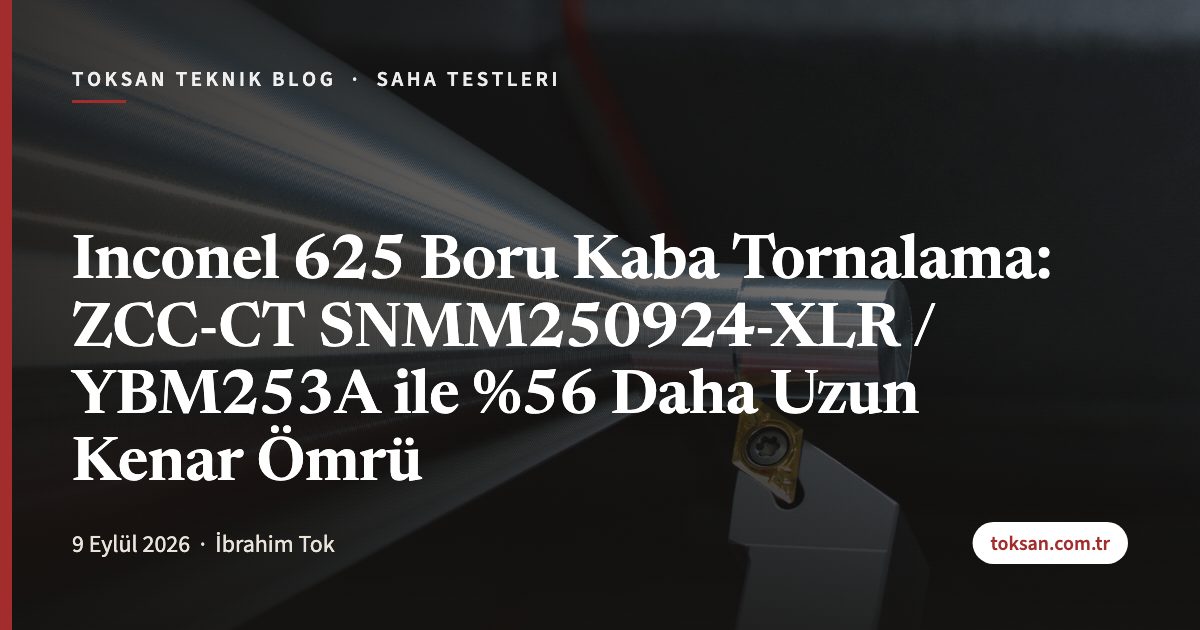
Rough turning Inconel 625 tube: 56% longer edge life with ZCC-CT SNMM250924-XLR / YBM253A
Rough turning a Ø1230 mm Inconel 625 pipe: 22.9 minutes per edge for the competing insert and 35.7 minutes for ZCC-CT XLR. An example of edge-life calculation for defence-industry components.
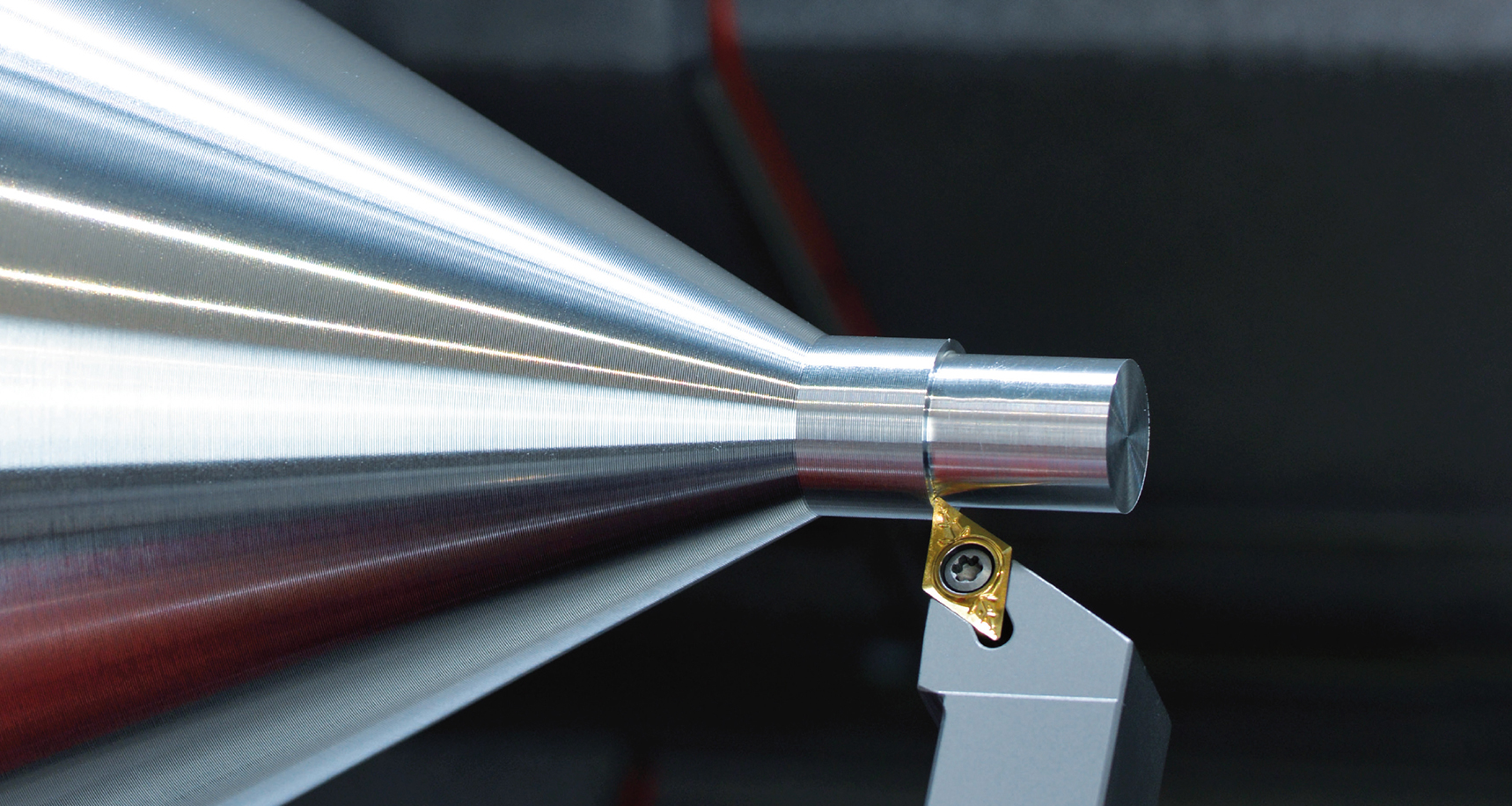
Türkiye’s defence industry has expanded its manufacturing capabilities, and cutting tools play an important role. Tool selection, spindle speed and feed affect quality. Limited edge life means downtime, edge changes and higher cost per part. Here we review a heavy turning Inconel 625 field trial. We measured the following result with ZCC-CT SNMM250924-XLR / YBM253A edge life 35.7 minutes, compared with 22.9 minutes for the competing insert, a difference of about 56% longer.
First published: Toksan Group LinkedIn, 9 September 2026 · Expanded edition. Catalogue data from the ZCC-CT General Turning Catalogue 2026.
Why is Inconel 625 difficult to turn?
Inconel 625 is a nickel-chromium superalloy designed to retain its strength at high temperatures. Its low thermal conductivity and rapid work hardening concentrate cutting heat at the edge rather than in the chip. The edge heats quickly and notch and crater wear accelerate. Insufficient edge life extends machining time. Cutting speeds are kept low, while higher feeds and depths of cut are chosen for productivity, so the edge remains heavily loaded even at low speed. Superalloys and titanium page gives an overview of machining this material group.
Field trial setup
| Parameter | Value |
|---|---|
| Workpiece | Inconel 625 tube, ø1230 mm — nickel-based superalloy |
| Machine tool | SKODA centre lathe, 100 kW |
| Machining operation | Rough turning with emulsion coolant, large diameter and heavy cut |
| Cutting speed Vc | 30 m/min |
| Feed f | 0.7 mm/rev |
| Depth of cut ap | 10 mm |
| Cut length | 200 mm |
| Inserts tested | Competitor SNMM250924-HR · ZCC-CT SNMM250924-XLR / YBM253A |
| Metric | Edge life T (minutes), 1 edge / 1 part |
Result: cutting-edge life
Under the same conditions, the ZCC-CT edge ran 12.8 minutes longer, a 56% increase in edge life. Fewer edge changes on a Ø1230 mm pipe also mean less downtime, less resetting and less risk of marks on the surface.
ZCC-CT XLR chipbreaker for heavy roughing
XLR is the chipbreaker ZCC Cutting Tools developed for roughing with negative inserts. It is available in CNMG, CNMM, DNMG, SNMG, SNMM and TNMG shapes. SNMM250924-XLRhas a 2.4 mm nose radius. The catalogue range is ap 2.0–7.8 mm and f 0.2–0.65 mm/rev. The field trial exceeded that range at ap 10 mm and f 0.7 mm/rev. Even under these heavy conditions the edge lasted 35.7 minutes.
What difference do grade and geometry make?
Choosing the right ZCC-CT grade and geometry slows wear and reduces cost per part. In roughing, the tough, thick-edged XLR geometry breaks chips and withstands impact. For finishing, grades developed for ISO S materials such as YBS103 are alternatives. The catalogue describes YBS103as a turning grade for nickel-based materials. A dedicated carbide substrate and new PVD coating provide excellent wear behaviour and high thermal stability (S10–S20). Separate grades for roughing and finishing make tool life in superalloys more predictable.
Applying the findings to defence-sector components
- Use a low cutting speed and higher feed and depth of cut on nickel alloys, with a strong, thick-edged roughing geometry to withstand the edge load.
- Maintain the coolant supply. Emulsion limits heat accumulation at the edge and reduces work hardening.
- Measure edge life in minutes and plan the number of edges per part. Schedule changes so they do not interrupt machining halfway through a part.
- Evaluate XLR for roughing and, for finishing, YBS103 a dedicated ISO S grade. Select each operation separately rather than using one insert for both.
Frequently asked questions
How was the 56% increase calculated?
(35.7 − 22.9) ÷ 22.9 = 0.56. An additional 12.8 minutes per edge.
Did the test exceed the catalogue range?
Yes. SNMM250924-XLR the catalogue recommends ap 2.0–7.8 mm and f 0.2–0.65 mm/rev. The field test used ap 10 mm and f 0.7 mm/rev. The result illustrates the geometry’s toughness in heavy cutting. For your own application, start within the catalogue range and increase the values gradually.
Which grade should I choose for finishing Inconel?
For ISO S materials, YBS103 (S10–S20) is a turning grade for finishing and semi-finishing nickel-based materials. Consider it with a chipbreaker that has a sharp geometry.
Select the grade, geometry and cutting data for your superalloy application with our team
For superalloy machining on defence and aerospace components, we can help you match the cutting grade, geometry and parameters to your operation.
Related pages: Aerospace · Power engineering · General turning · When the insert lasts only 20 parts on a 42CrMo4 shaft