Why does stainless steel heat up so quickly during drilling? 🔥
Drilling difficulties in stainless steel are often put down to the material being too hard. For many grades, low thermal conductivity and a tendency to work harden are at least as important. More of the heat from cutting stays in the cutting zone, and the chips may carry away less of it than intended. If the drill rubs instead of cutting, the bore wall starts to work harden and the next few millimetres become harder to drill than the last. 😬 The resistance the drill encounters can therefore change with every millimetre of depth.
Toksan’s on the holemaking page emphasises that coatings resistant to adhesion and the right tool combinations improve the internal surface finish when drilling stainless steel. The same page highlights high precision, long tool life and material-specific series that reduce the cost per hole. A general-purpose drill may be adequate for some simple jobs. Where heat control is important, a material-specific geometry often makes a difference.
When drilling stainless steel, is the problem low speed, incorrect feed or inadequate cooling? ⚖️
Often all three have been set without considering how they interact 😊 A common shop-floor mistake is to lower spindle speed to protect the drill and also cut feed too far. That may look safe, but an excessively light feed can make the drill polish and rub. Heat can build up locally and do more damage. A shiny hole may be an early sign of work hardening.
In its drilling guidance, Sandvik Coromant suggests considering a higher feed when work hardening is a problem and notes that high-pressure coolant can improve performance. Kennametal recommends sharp tools, the specified speed and feed, avoiding dwell, and keeping feed as constant as possible. Where pecking is necessary, it recommends fewer, more controlled pecks. Seco identifies through-tool coolant as the preferred option for drilling difficult materials, particularly stainless steels and superalloys. In practice, the aim is to form a chip without rubbing, clear the chips and control the heat. :contentReference[oaicite:0]{index=0}
| Scenario | Initial assumption | Actual risk | Recommended approach |
|---|---|---|---|
| Reducing spindle speed too far | Assumed to protect the tool | Friction may increase and heat can remain localised | Material-appropriate cutting speed and effective feed |
| Reducing feed too far | Assumed to improve the surface finish | Rubbing replaces cutting, increasing work hardening | Consistent, sufficient chip thickness |
| No coolant or insufficient flow | May seem adequate for a simple job | Chip evacuation and temperature control deteriorate | Through-tool coolant or a strong, directed flow |
| Frequent pecking | Assumed to clear chips more easily | Repeated re-entry increases heat and work hardening | If necessary, use a small number of controlled pecks |
How should cutting parameters be set to reduce heat build-up? 🧠
I find five questions more helpful than memorising individual settings 😊 Is the drill really cutting? Are the chips leaving the hole regularly? Does coolant reach the cutting zone? Is the drill advancing steadily with as little vibration as possible? Can the strategy avoid unnecessary withdrawal and re-entry? When these checks are satisfied, heat usually becomes easier to manage.
Toksan there are two features that support this approach. The first is the product range distinguishes between general-purpose and material-specific solid carbide drill series. The second point is that custom tooling and testing process notes that the through-coolant passages and helix angles can be tailored to the hole’s depth-to-diameter ratio. A 3×D hole in stainless steel calls for a different approach from an 8×D hole. Chip evacuation and coolant flow become more important as depth increases. :contentReference[oaicite:1]{index=1}

Why is steady feed so important when drilling stainless steel? 📏
Dwelling in a stainless steel bore, reducing the feed unnecessarily or letting only part of the cutting edge engage is a common starting point for trouble. When the edge stays in contact without removing enough material, much of the energy goes into heat and surface deformation. Kennametal recommends keeping feed as constant as possible and avoiding dwell inside the hole. Where peck drilling is necessary, the same guidance recommends minimising the number of pecks and retracting by roughly one tool diameter on each peck to clear the chips. The aim is to maintain a controlled, effective cut. :contentReference[oaicite:2]{index=2}
I put it this way: stainless steel responds poorly to hesitation. 😊 An unsteady feed can quickly make the surface harder to cut. Entry may look normal, then the drill starts to sound different, the chips darken and the bore finish deteriorates. The underlying cause is often instability in the operation, even when the material appears to have hardened suddenly.
Why does internal coolant make such a difference when drilling stainless steel? 💧
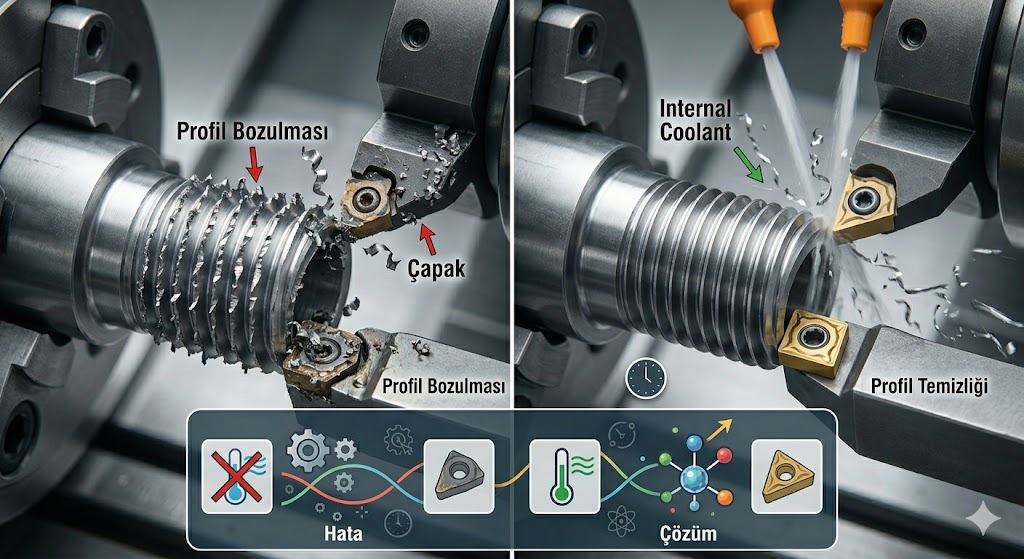
Through-tool coolant does more than cool the drill. It controls temperature in the cutting zone, helps carry chips out of the hole and lubricates the cutting edge to reduce friction. Seco recommends through-tool coolant for drilling and identifies it as the preferred option for difficult materials such as stainless steel. Sandvik also notes the performance benefits of high-pressure coolant. For stainless steel, through-tool coolant can therefore make a substantial difference to process reliability. :contentReference[oaicite:3]{index=3}
Toksan’s custom tool manufacturing explains that internal coolant channels can be designed for the depth-to-diameter ratio. This is particularly important in long holes and stainless grades prone to adhesion, where the design affects stability all the way to the bottom. In this context, Toksancan recommend a solution based on an analysis of the process. A through-coolant drill may look suitable on paper, but an optimum result depends on assessing the actual flow, the machine and the workpiece geometry together.
Spotting failure patterns early can save the tool 🚨
Common mistakes in stainless drilling follow a pattern. First, a very light feed is mistaken for safe drilling. Second, short, frequent pecks repeatedly cause rubbing in the hole. Third, a dull drill is pushed through a few more holes. Fourth, insufficiently rigid holding lets the drill run off axis. Fifth, the entry surface is poorly prepared. Sixth, no one watches the chip shape. Chips report on the process as it runs 😊 Heavy discolouration, broken or burnt chips, or chips collecting at the hole entrance often signal poor heat management early.
Toolholders and accessories in the area of Toksan emphasises that vibration, imbalance and misalignment reduce surface quality and tool life. This is especially important in drilling: when the drill runs off centre, one lip carries more load, heat becomes unevenly distributed, and bore diameter and tool life both suffer. For the same reason, tooling technology and the right clamping system should be treated as process parameters in their own right when drilling stainless steel. :contentReference[oaicite:4]{index=4}
Worked example: planning a 5×D hole in 316L stainless steel 🛠️
Suppose you are drilling a 12 mm hole, 5×D deep, in 316L. The first two holes are clean. From the third hole onward, the drill sounds different, chips start to jam and slight discolouration appears around the hole entrance. I would check feed stability first. An operator may have reduced the feed to ease the cut. Next, check whether coolant reaches the bottom of the hole or merely circulates outside. Inspect the cutting edge for early dulling that may cause rubbing, then check clamping and overhang. Adjusting cutting conditions before tackling these points often just delays the problem.
At this point, Toksan’s general engineering solutions, automotive and medical technology where high-precision bores matter, makes particular sense here. Success in drilling stainless steel is measured by the ability to reproduce the same hole quality consistently, as well as by the initial choice of drill.
Why can “drill a little more gently” sometimes be expensive advice? 😅
I still remember being told in a shop years ago, “You have to drill stainless steel cautiously.” The advice was well meant, but in that case it led to low feed, longer cycles, rapidly rising heat and shorter drill life than expected. We reviewed the geometry, improved cooling, stabilised the feed and reduced the number of pecks. The new process looked more aggressive but was better controlled and ran cooler. I learned to machine stainless steel consistently rather than timidly ❤️
A rule of thumb from practice: read the chips 🧩
The first thing I like to inspect when drilling is the chip. Even when the settings look right, poor chips suggest the process will not stay stable. If they darken, fail to curl out and collect at the entrance, heat may be building up inside the hole. Before revising the data sheet, find out why they cannot escape. The answer might be a through-coolant drill, more rigid clamping, a different coating or a steadier feed. Toksan’s regrinding service and the emphasis on maintaining hole tolerances are related. When the cutting edge loses its sharpness, a change in chip formation is often the first noticeable sign. :contentReference[oaicite:5]{index=5}
DRILLING STAINLESS STEEL: DECISION TREE

Start
   ↓
Is the tool sharp?
   ├─ No → Change the tool or check the regrind
   └─ Yes
        ↓
Is the feed steady and sufficient?
   ├─ No → Risk of rubbing and work hardening
   └─ Yes
        ↓
Is internal coolant or an effective coolant flow available?
   ├─ No → Poorer heat dissipation and chip evacuation
   └─ Yes
        ↓
Are chips being evacuated consistently?
   ├─ No → Review peck drilling, geometry or coolant flow
   └─ Yes
        ↓
Are the holder and workpiece clamping rigid?
   ├─ No → Misalignment and uneven heat distribution
   └─ Yes
        ↓
Result: cooler, more stable and more repeatable drilling
A cool drilling process in stainless steel can still run at speed ✅
To keep a stainless drilling operation cool, simply reducing spindle speed is rarely enough 😊 Set the process so the drill cuts cleanly, chips leave the hole regularly, coolant reaches the cutting zone and the drill avoids unnecessary dwell. Consider the cutting speed, adequate steady feed, internal coolant where available, rigid clamping, suitable geometry, controlled pecking and timely tool changes together.
Toksan’s industrial solutions approach and technical support approach matters to me because successful stainless steel drilling depends on reading the actual application properly. A single catalogue figure tells only part of the story. In deep holes, close-tolerance work or high-volume production in particular, Toksan that considers tooling, testing, regrinding, training and clamping together can make a difference. Drilling stainless steel calls for discipline, consistency and a properly planned process. 🚀
Frequently asked questions ❓
1) Why does the tool heat up quickly when drilling stainless steel?
Stainless steel conducts heat away less readily than ordinary steel and is prone to work hardening. Once the drill starts rubbing instead of cutting, heat builds up quickly.
2) Is it always safe to reduce the feed?
No. Too little feed can cause rubbing and increase work hardening.
3) Is internal coolant essential?
Some jobs do not require it. It can offer a substantial advantage in stainless steel and demanding drilling conditions.
4) Is peck drilling always wrong?
No. Use it if required, but unnecessarily frequent pecking can increase heat and the risk of work hardening.
5) Why is it harmful to let the drill dwell in the hole?
Because rubbing and local heating can dominate during this stage.
6) Why does chip colour matter?
Chips provide a quick indication of heat and evacuation behaviour. Excessive discolouration or accumulation can indicate a problem.
7) Is a general-purpose drill adequate for stainless steel?
It can be for some jobs. For series production or precision applications, material-specific geometry can give more reliable results.
8) Does the holder really make that much difference?
Yes. Misalignment and vibration can accelerate heating and wear.
9) Can a reground tool drill stainless steel?
Controlled, appropriate regrinding can restore performance on many drills. The critical point is to preserve the original geometry and tolerances.
10) What is the single most important piece of advice?
When drilling stainless steel, keep the tool cutting and avoid rubbing inside the hole.
People also ask 🔎
Why does drilling 316L stainless steel feel different from drilling 304?
How can you recognise material adhesion on a drill in stainless steel?
How can drilling stainless steel be optimised on a machine without internal coolant?
At what depth-to-diameter ratio should peck drilling be considered more seriously?
What does purple discolouration at the hole entrance indicate?
Is spot drilling necessary in stainless steel?
When is an indexable drill preferable to a solid carbide drill?
What should you check before reaming a hole in stainless steel?
Why is it harder to drill a work-hardened hole again?
If the hole diameter increases, is it the parameters or the holder?